
For people who love real estate, looking at listings can be a captivating hobby, especially when the homes are beautifully staged and the photos are high quality. We’re very fortunate to work with a few select, local photographers who have an incredible talent for bringing out the best qualities and features of our properties, much like a gifted portrait photographer brings out the best in their human subjects.
But if you’ve recently tilted your head at listing photos, wondering if they’re real, you’re not alone. A recent article in the New York Times described the increased use of AI in real estate listings, and in some cases, the misuse.
The article called out not only instances where AI exaggerated natural light or improved views in listing photos, but more egregious, placed non-existent architectural details and features like fireplaces.
Showing a home in its best light, from its best angle is one thing, but the misrepresentation of a property is a serious violation of the code of ethics we adhere to as real estate professionals.
Whether performed by a professional or the homeowners themselves, staging a home is exceptionally important to both high-quality photographs and successful in-person showings. However, there are instances—for example, a vacant home—where virtual staging can help people looking for a home envision spaces.
With that in mind, we want to assure you that we accurately and honestly represent our listings.
Occasionally, we do use virtual staging to help buyers understand spaces:
- This virtual staging is minimal, with simple placings of basic furniture and a few home decor items.
- This can be especially helpful with vacant properties.
- It also helps buyers envision the use of open floor plans and great room concepts.
We never:
- Exaggerate natural lighting or views.
- Artificially replace existing finishes including paint colors, flooring or countertops.
- Distort dimensions or change the layout.
- Move existing architectural features including doorways, windows or stairs.
- Add non-existent architectural features such as windows or fireplaces.
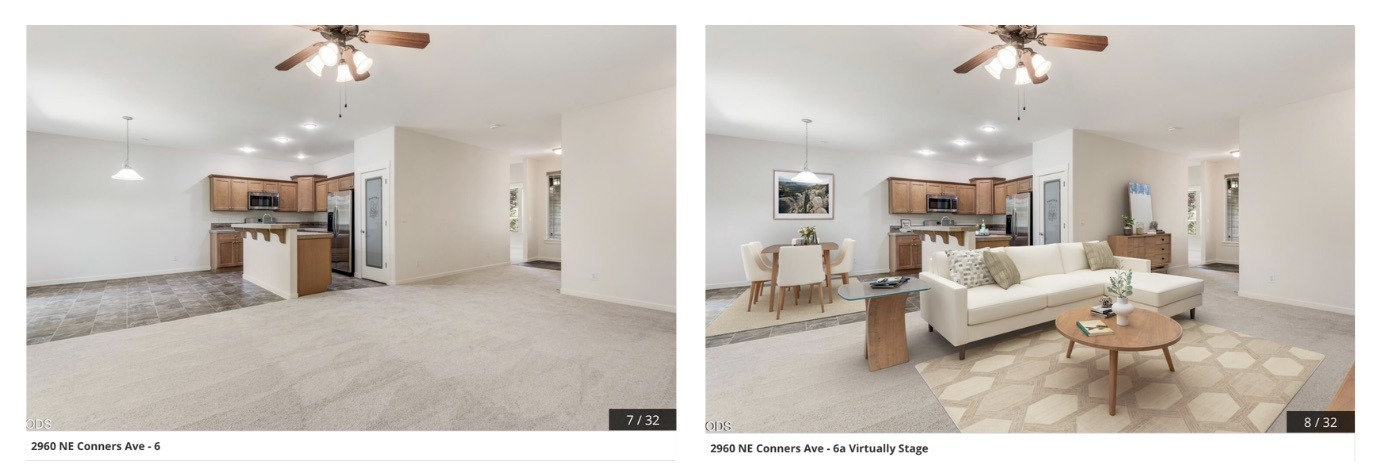
One of our recent listings was a well-maintained home with a great-room floor plan. Because the home was vacant, we used virtual staging to help potential buyers envision the layout of the open living space. The staged photo is clearly labeled as using virtual staging in the caption on the MLS.
A best practice we adhere to when using virtual staging in a listing is to include a photo of the space without it. For example, our listing might have an image taken by our photographer of an open floor plan without any furniture or decor, and then another staged with living area furniture, a dining table and counter stools. And, when we do use virtual staging, the images with virtual staging are annotated specifically as such on the MLS (Multiple Listing Service).
Navigating the use of AI is a challenge for every industry right now, and we are committed to being completely transparent and ethical in our listings.
—Kimberly
